01
1. 3M's exit from the market and domestic substitution opportunities
1.1 > 3M Exit Background
3M has decided to completely stop the production of PFAS, including e-fluorinated liquids and fluoropolymer products, by the end of 2025. This move undoubtedly provides a huge opportunity for domestic substitution for domestic enterprises.
1.2 > Opportunities for domestic substitution
3M once held 57% of the market share, and its exit is bound to free up a broad market space. At the same time, with the rapid advancement of artificial intelligence technology and the urgent need for high-performance computing power, equipment cooling is facing more severe challenges. It is expected that by 2025, the market size of China's liquid-cooled data center will reach 128.3 billion yuan, of which the immersion liquid cooling market will account for 52.6 billion yuan, accounting for more than 40%. The rapid expansion of immersion liquid-cooled data centers will simultaneously stimulate demand for coolants, especially e-fluoride fluids.
022. Introduction to fluoride liquid and market changes
2.1 > Definition and application of fluorinated liquid
Fluorinated liquids, also known as fluorinated organic compounds, are a class of liquids that have been specially synthesized. They form this unique class of substances by replacing some or all of the hydrogen atoms in hydrocarbons with fluorine atoms. These liquids are typically colorless, odorless, and transparent, while exhibiting excellent chemical inertness and physical stability. The C-F bond energy in their molecules is as high as about 485 kJ/mol, which gives them excellent reactivity resistance, non-flammability, and wide temperature adaptability, and can work stably in the temperature range from -50°C to over 200°C. Fluoride liquid is mainly used in high-end fields such as precision electronic cleaning and aerospace. However, as its excellent insulation and thermal management properties are gradually discovered, fluoride liquid is increasingly used in high-end scenarios such as data center liquid cooling and semiconductor manufacturing, becoming an indispensable core material.
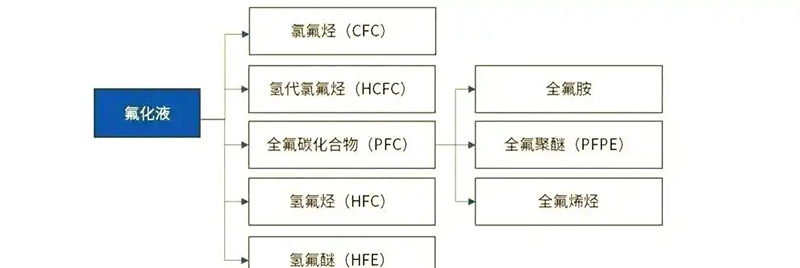
2.2 > Main types and competitive advantages of fluorinated fluids
Fluoride liquids, according to their molecular structure and composition, can be divided into four categories. The first is perfluoropolyether (PFPE), which is composed of carbon, fluorine, and oxygen atoms, including D, K, Y, and Z. These fluoride fluids are characterized by their high boiling point (over 150°C), low volatility, and excellent lubricity, making them ideal for use in data center immersion cooling and semiconductor equipment.
Another important fluorinated liquid is hydrofluoroether (HFE), the boiling point and viscosity of which can be controlled by adjusting the length of the perfluoroalkyl to perhydroalkyl chains. This type of fluoride has a low global warming potential (GWP less than 150) but a relatively high dielectric constant, so it is widely used in the field of cleaning and refrigeration.
In addition, there are perfluoroolefin fluorinated fluids, represented by hexafluoropropylene dimers and trimers, which are characterized by low viscosity and low dielectric constant, making them ideal for immersion liquid cooling applications. There is also a class of perfluorocarbons (PFCs), including perfluoroamines, perfluoroalkanes, etc., which have excellent insulating properties. However, it should be noted that their global warming potential (GWP value) is relatively high.
2.3 > Market Application of Fluorinated Fluids
In terms of insulation safety, fluoride fluids have a dielectric strength of up to 20–40 kV/mm, which far exceeds that of air by 3 kV/mm, which allows it to come into direct contact with electronic components without worrying about short circuits. Its thermal conductivity reaches 0.06–0.09 W/m·K, which is more than 100 times higher than that of air. Its low viscosity nature accelerates fluid circulation, allowing heat from high-power chips to be quickly taken away and reducing the temperature of the GPU cluster. In addition, fluoride fluids are non-corrosive and can extend the service life of the equipment. Fluoride fluids also play an important role in data center liquid cooling and semiconductor manufacturing, enabling high-density power devices to achieve energy savings while also achieving energy savings.
2.4 > Global Market Distribution and Manufacturers
From the perspective of market share, the global electronic fluoride fluid market shows a significant concentration trend. The top five manufacturers collectively occupy about 80% of the market share, of which 3M holds the top position with about 57%. Europe has become the world's leading electronic fluoride fluid market, accounting for 52% of the share; The United States and China followed with 20% and 15% market shares, respectively.
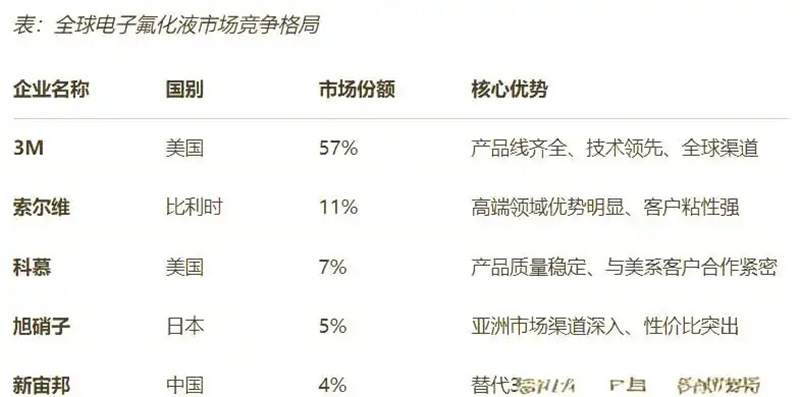
In the fierce competition in the global electronic fluoride fluid market, many outstanding enterprises have emerged. With advanced technology and products, these companies are committed to promoting continuous innovation and development in the industry. Here are a few highly regarded global fluoride fluid producers:
3M: As a leader in the global electronic fluorination fluid market, 3M has firmly established its market dominance with its excellent product quality and innovation capabilities.
Japan Zhongyuan Chemical Industry Co., Ltd.: With its high-quality products and professional technology, it has won wide recognition in the market.
Toray Corporation of Japan: With deep technology accumulation and rich product line, it is highly trusted by customers.
Solvay: occupies a global position in the field of fluoride liquids, and monopolizes the global high-end fluoride liquid market with many companies.
Chemours: With its unique hydrofluoroolefin (HFO) technology route, it occupies a leading position in the market.
Juhua Co., Ltd. and New Zhoubang: As a leading enterprise in China electronic fluoride liquid, its self-developed products meet the requirements of advanced processes.
Haohua Technology (Sinochem Blue Sky): Through mergers and acquisitions, the integration of the entire fluorine chemical industry chain has become the core force of domestic substitution.
Qianhai Jiaxin: It is one of the few enterprises in the world that has mastered the core technology of high-end water-based electronic fluorination liquid.